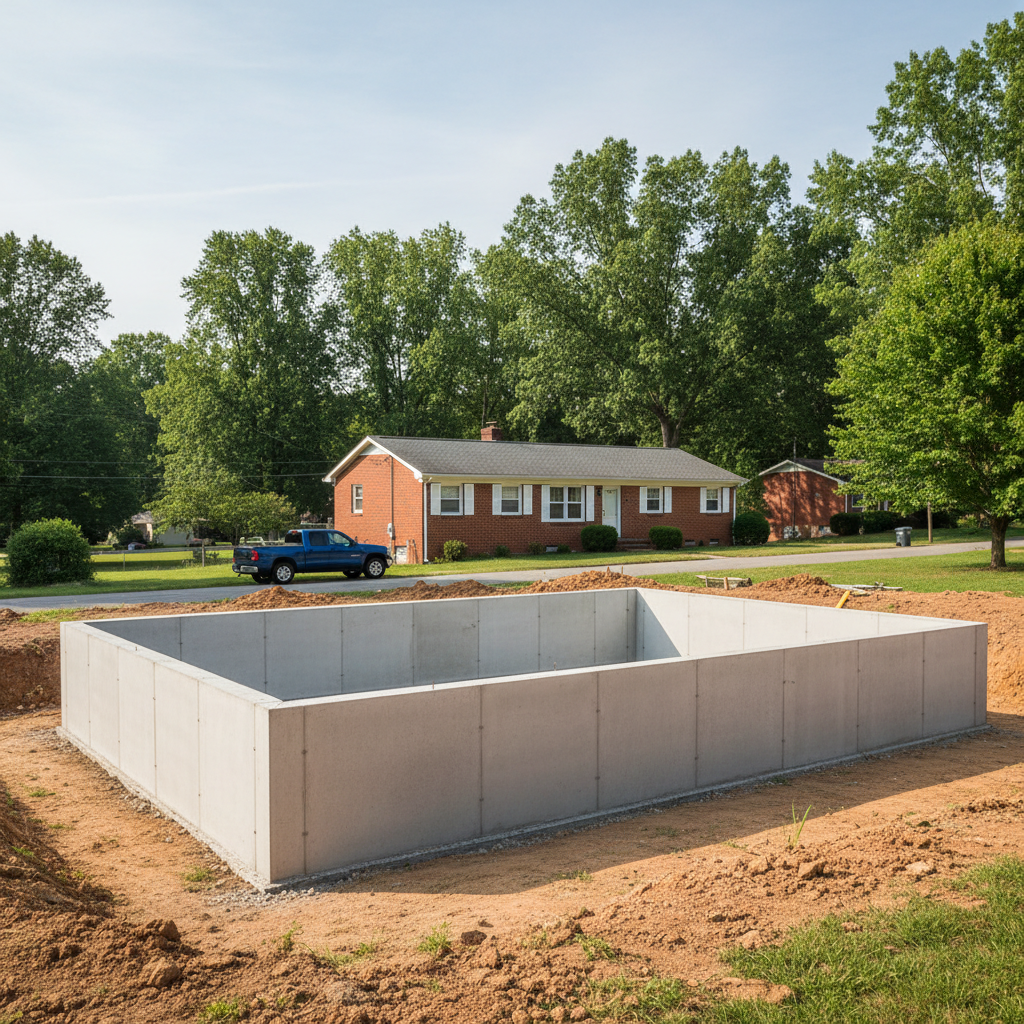
Bowie gets a lot of concrete bids that look the same on paper. Everybody promises a driveway or patio that will last. The difference between a slab that's still flat in fifteen years and one that's heaving and spalling by year five usually comes down to things you can't see once the concrete is poured: how thick it is, what's under it, and whether anyone bothered to think about this county's soil and weather before they started.
What the ground here actually does
A good chunk of Prince George's County sits on clay, and parts of it sit on something called Marlboro clay, a geologic layer known locally for being unstable when it gets wet. It swells, it shifts, and it's part of why some older slopes around the county have a history of slow movement. You don't need to know the geology to care about the result: a slab poured on soft, unprepared, or poorly compacted clay subgrade will crack and settle no matter how good the concrete mix is above it.
A contractor who knows the area will compact the base properly, usually 4 to 6 inches of crushed stone, and grade it so water sheds away from the house instead of pooling under the slab. On older lots in Old Bowie or around Belair, where the ground has been built on since the 1960s, there's often buried debris, old tree roots, or fill dirt from the original construction that has to be dug out before a new patio or driveway goes in. Newer subdivisions like Fairwood tend to have more consistent, engineered fill, but even there the clay underneath doesn't drain fast, so grading still matters.
Why the freeze-thaw cycle matters more than people think
Bowie winters aren't brutal, but they're not mild either. We typically get a couple dozen freeze-thaw cycles between December and February, where the ground freezes at night and thaws during the day. Water that's soaked into concrete expands when it freezes. Over enough cycles, that's what causes the surface to flake and pit, a problem called scaling or spalling. The fix isn't exotic: concrete mixed with air-entrainment, tiny microscopic air bubbles, gives that water somewhere to go when it expands. Any contractor pouring a driveway or set of steps in this climate should be using an air-entrained mix without you having to ask. If they don't know what air-entrainment is, that's worth noting.
Summer brings the opposite problem. July and August here regularly hit the 90s with high humidity, and concrete that cures too fast on a hot, sunny day can crack before it ever gets load on it. A contractor who pours in summer should be wetting the forms, working early in the day, and covering fresh concrete with curing blankets or spray, not just pouring it and leaving.
What a real quote should spell out
A lot of lowball bids get cheap by shaving the slab thickness or skipping steel. Here's roughly what a legitimate quote should specify, not just imply:
- Thickness: 4 inches for a standard driveway or patio, sometimes 5 to 6 inches if it's going to carry a lot of vehicle weight.
- PSI strength: 3,500 to 4,000 PSI is standard for residential driveways in this climate. Anything lower is cutting corners for freeze-thaw durability.
- Reinforcement: either welded wire mesh or rebar, usually #3 or #4 bar on a grid, depending on the application. Mesh that isn't lifted up into the middle of the pour during placement does almost nothing, so ask how they hold it in position.
- Control joints: cut or tooled every 8 to 10 feet to control where the slab cracks, because it will crack somewhere eventually. These should go in within the first 24 hours after the pour, before the concrete decides on its own where to split.
- Cure time: expect about 24 to 48 hours before you can walk on a new slab, and 5 to 7 days minimum before a car drives on it. Full strength takes closer to 28 days. Anyone telling you to park a truck on it the next day is setting you up for problems.
None of this needs to be complicated. It just needs to be written down, with the thickness and PSI spelled out in the contract, not left as a verbal promise.
Permits, inspections, and HOAs
Most concrete work in Bowie, from a new driveway to a retaining wall over a certain height, goes through Prince George's County's permitting process, since Bowie sits within the county even though it has its own city government for some services. Sidewalks and driveway aprons that touch the public right-of-way often need separate sign-off because they affect drainage and road access. An inspector typically wants to see the site before the pour, checking the base prep and forms, and sometimes again after, depending on the scope.
If your property is in one of the newer planned communities, Fairwood or Woodmore for example, there's a good chance you're also dealing with an HOA that has its own rules on finish, color, or even where a driveway can be widened. A contractor who's worked in those neighborhoods before will know to check the HOA paperwork before pouring, not after. Skipping that step is a common reason homeowners end up having to redo work they already paid for.
What to walk away from
A bid that's dramatically lower than the others is almost always lower because something's been left out, usually the base prep, the rebar, or the thickness. Ask what's not included before you ask what the price is.
Be cautious of anyone who wants full payment up front, in cash, with no contract. A legitimate contractor is used to a deposit and a balance on completion, with the scope, thickness, and PSI written down. If they can't tell you what mix they're using or won't pull a permit when one's required, that's not a small detail to overlook, it's the whole job.
Ask how long they've worked in this county specifically. Someone who's dealt with Prince George's clay, the local freeze-thaw pattern, and the permitting process here is going to make different decisions on your job than someone pouring their first slab in the area. That local knowledge doesn't show up in a glossy brochure, it shows up in how the base is compacted and when the joints get cut.
If you want to see how we handle base prep, mix specs, and permitting on jobs around Bowie, take a look at Elite Concrete Company and what we've got going on.